Saint Teresa of Avila
the one of “God alone suffices”
Who was Saint Teresa of Avila?
- She was born in Ávila, Spain, in 1515. Her name was Teresa de Ahumada. Benedict XVI, general audience of February 2, 2011
- She was a Carmelite nun and founded seventeen convents. Benedict XVI, general audience of February 2, 2011
- In 1970 she became the first woman proclaimed a Doctor of the Church. Paul VI, homily of September 27, 1970
- The name
- When she became a nun, she took the name Teresa of Jesus. Benedict XVI, general audience of February 2, 2011
- Also called
- Teresa de Ahumada Benedict XVI, general audience of February 2, 2011 · Saint Teresa of Ávila Benedict XVI, general audience of February 2, 2011
- From
- Ávila, Spain Benedict XVI, general audience of February 2, 2011
- Occupation
- Carmelite nun, foundress and writer Paul VI, homily of September 27, 1970
- Feast day
- October 15: Saint Teresa of Jesus, Virgin and Doctor of the Church
The path of Saint Teresa of Avila
- Before Jesus. As a girl she read the lives of martyrs and told her parents that she wanted to see God. Benedict XVI, general audience of February 2, 2011
- Before Jesus. When she was 12, her mother died. Teresa asked the Virgin Mary to be her mother. Benedict XVI, general audience of February 2, 2011
- With Jesus. At 20 she entered the Carmelite Monastery of the Incarnation, in Ávila. Benedict XVI, general audience of February 2, 2011
- With Jesus. For years she struggled with her weaknesses. In Lent of 1554, an image of the badly wounded Christ changed her deeply. Benedict XVI, general audience of February 2, 2011
- With Jesus. In 1562 she founded the first reformed Carmel in Ávila. In all, she founded seventeen. Benedict XVI, general audience of February 2, 2011
- With Jesus. In 1568, with Saint John of the Cross, she opened the first convent of Discalced Carmelite friars, in Duruelo. Benedict XVI, general audience of February 2, 2011
- With Jesus. She died in Alba de Tormes in October 1582, on her way back from founding the Carmel of Burgos. Benedict XVI, general audience of February 2, 2011
- Afterward. She was canonized in 1622. In 1970, Paul VI proclaimed her a Doctor of the Church. Paul VI, homily of September 27, 1970
Words of Saint Teresa of Avila
“I want to see God.” The Book of Her Life 1, quoted by Benedict XVI, general audience of February 2, 2011
As a girl, to her parents.
“Let nothing trouble you, / let nothing frighten you. / Everything passes, / God never changes. / Patience / obtains all. / Whoever has God / wants for nothing. / God alone is enough.” Poem 30, in Catechism 227
A poem of hers that the Catechism calls a prayer.
“Mental prayer, in my opinion, is nothing else than a close sharing between friends; it means taking time frequently to be alone with him who we know loves us.” The Book of Her Life 8, in Catechism 2709
Explaining what it is to pray.
“In the end, I die as a daughter of the Church.” Benedict XVI, general audience of February 2, 2011
Before she died, in Alba de Tormes.
What they were like
- She came from a large family: she had nine brothers and three sisters. Benedict XVI, general audience of February 2, 2011
- She had no academic training, but she learned from theologians and spiritual masters. Benedict XVI, general audience of February 2, 2011
- She wrote only about what she had lived herself or seen others live. Benedict XVI, general audience of February 2, 2011
The greatest thing they did
- She reformed the Carmelite Order and founded seventeen Carmels. Benedict XVI, general audience of February 2, 2011
- She taught people how to pray: Paul VI says her message is “the message of prayer.” Paul VI, homily of September 27, 1970
Not to be confused with
- Saint Thérèse of Lisieux: Saint Thérèse of Lisieux was a Carmelite in France three centuries later. She followed the path that Teresa of Jesus had opened. John Paul II, apostolic letter Divini Amoris Scientia 5
- Saint Teresa of Calcutta: Mother Teresa lived in the twentieth century and founded the Missionaries of Charity in India. vatican.va, biography of Mother Teresa
- She has the same name, but she is a different Carmelite: she lived from 1900 to 1920. vatican.va, biography of Saint Teresa of Jesus of the Andes
In the Church today
Feast day: October 15, Saint Teresa of Jesus, Virgin and Doctor of the Church (memorial). General Roman Calendar; the date: Pope Francis, C’est la confiance (October 15, 2023, “memorial of Saint Teresa of Ávila”)
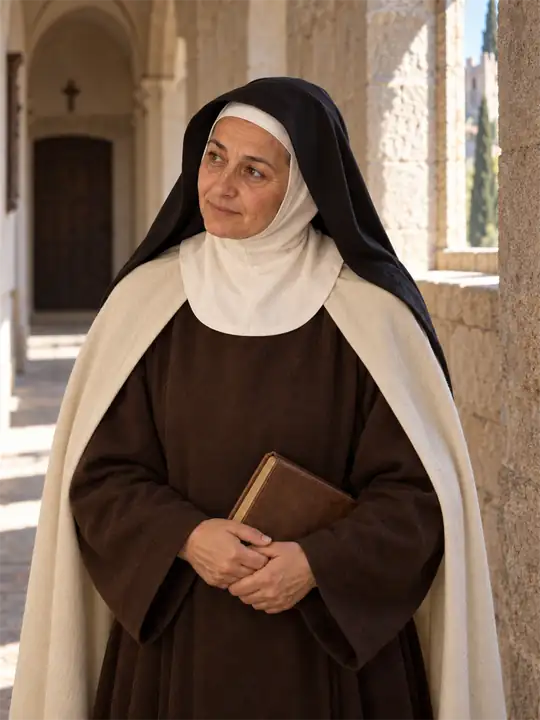
In art, recognized by: A book and a quill pen, for her writings This is how Christian art shows her; her works, Benedict XVI, general audience of February 2, 2011; The brown habit and white mantle of the Discalced Carmelites This is how Christian art shows her
What people ask
Why is she called Teresa of Jesus?
It is the name she took when she became a nun. Before that, her name was Teresa de Ahumada. Benedict XVI, general audience of February 2, 2011
What is a Doctor of the Church?
It is a title the Church gives for “eminence of doctrine.” Teresa was the first woman to receive it. Paul VI, homily of September 27, 1970
Why is her feast on October 15?
She died on October 4, 1582, the very day the calendar was changed. The next day became October 15. John Paul II, letter of October 14, 1981
What books did she write?
The Book of Her Life, The Way of Perfection, The Interior Castle and The Book of the Foundations, among others. Benedict XVI, general audience of February 2, 2011
Her struggle As a teenager, worldly books drew her into the distractions of a worldly life. Benedict XVI, general audience of February 2, 2011 Even as a nun, she struggled…
The rest of this page (daily life, failings, little-known facts, for you…) is part of the subscription.
See the mapWho Saint Teresa of Avila is connected to
- Saint Thérèse of Lisieux · followed her path
- Saint Francis Xavier · canonized on the same day
- Mary · asked her to be her mother
- Jesus · took his name
More people
All the people of the Bible · The Twelve Apostles · Women of the Bible